
CategoriesLMS

LMS For Schools And Colleges: A Comprehensive Guide to Transforming Education

LMS for Schools and Colleges

A Comprehensive Guide to Transforming Education

LMS for Schools and Colleges in 2025

Revolutionizing Education Management Empower staff, engage students, and connect with parents like never before.


The world is online—and education is no exception. From ordering groceries to mastering a new language, smartphones and digital platforms have reshaped daily life. Schools and colleges are riding this wave, swapping outdated paper trails for sleek, tech-driven solutions. By 2026, experts predict the digital education market will soar past $336 billion, fueled by tools like e-learning apps, virtual classrooms, and online assignments. This isn’t just a trend—it’s a transformation.
 
Why are schools leading the charge? Digital tools unlock vast opportunities: teachers save time, students learn flexibly, and institutions stay competitive. A school embracing EdTech doesn’t just keep up—it stands out, earning respect from peers and trust from tech-savvy families. In 2025, parents and students demand more than traditional methods; they want education that prepares learners for a fast-paced, independent future. Outdated systems simply don’t cut it anymore.
 
The question is: How do you make your school a beacon of modern education? The answer lies in a robust Learning Management System (LMS)—a game-changer for management, teaching, and learning.
 
LMS for Schools and Colleges in 2025
Here’s what an LMS brings to the table: Course Creation: Administrators craft detailed online curricula—complete with lessons, schedules, readings, and assignments—customized for each subject. Online Assessments: Teachers whip up quizzes, exams, and projects, assign scores, and let the system tally grades automatically. Reporting Dashboards: Get a bird’s-eye view of student performance—grades, attendance, trends—all in real time, accessible to educators and learners alike. Virtual Classrooms: Host live classes via video conferencing, with recordings and materials available on-demand, across phones, tablets, or laptops.

What Is a Learning Management System (LMS)?

What Is an LMS?

An LMS is a software platform designed to streamline education by managing, delivering, and tracking courses and content. Think of it as a digital hub tailored to your school’s mission—whether that’s boosting student outcomes, simplifying admin tasks, or connecting with parents. It’s adaptable and scalable, growing with your needs and supporting learners of all kinds.


Here’s what an LMS brings to the table:


  • Course Creation: Administrators craft detailed online curricula—complete with lessons, schedules, readings, and assignments—customized for each subject.
  • Online Assessments: Teachers whip up quizzes, exams, and projects, assign scores, and let the system tally grades automatically.
  • Reporting Dashboards: Get a bird’s-eye view of student performance—grades, attendance, trends—all in real time, accessible to educators and learners alike.
  • Virtual Classrooms: Host live classes via video conferencing, with recordings and materials available on-demand, across phones, tablets, or laptops.
An LMS tackles everyday challenges head-on:

  • Tracking student progress with detailed reports
  • Sending instant notifications to parents about grades or events
  • Running assessments and sharing results instantly
  • Offering tailored lessons for individual learners
  • Fostering seamless collaboration between teachers, students, and parents
  • Cutting administrative busywork so teachers can focus on teaching
  • Boosting engagement with anytime, anywhere access
It’s not here to replace the classroom—it’s here to enhance it, blending tradition with innovation for a richer student experience.
 

Benefits of LMS for Schools

How to Make the Most of an LMS in Schools and Colleges

Embrace Blended Learning

Why choose between online and offline when you can have both? Blended learning mixes in-person teaching with digital tools, adapting to your school’s goals. Picture this: A science class dissects a frog in the lab one day, then reviews interactive 3D models online the next. It keeps things fresh, fights boredom, and lets students learn at their own pace.

Benefits? Students can catch up on missed lessons from home, connect with peers online, and enjoy a flexible schedule. Teachers gain insights into who’s thriving and who needs support, all through the LMS. It’s a win-win that balances structure with freedom.

Gamify Learning for Engagement

Gamification turns education into an adventure. Add points for completed assignments, leaderboards to spark friendly competition, or levels that unlock as students master topics. Imagine a history class where students earn “Explorer Badges” for quizzes or climb a leaderboard by debating key events.
The payoff: Students stay motivated, emotionally hooked, and socially engaged. Data backs this up—studies show gamified learning boosts retention by up to 14%. But don’t overdo it. Assess your students’ maturity, subject complexity, and goals before rolling out features. (Want more? See our blog: Gamification in Education: Benefits, Risks, Examples.)

Differentiate for Every Learner

No two students learn the same way. In a typical classroom, teachers juggle fast learners and stragglers, often rushing to meet deadlines. An LMS changes that. It lets you create tiered lessons—say, basic math for beginners and advanced problems for quick learners—all tracked individually.

For example, a struggling student might revisit a video tutorial while a top performer tackles bonus challenges. The LMS monitors pace and progress, alerting teachers to intervene when needed. It’s personalized education without the chaos.

Collect Honest Feedback

Feedback is gold, and an LMS makes it easy to get. Build surveys into courses—ask students what’s working or rate lessons from 1-5 stars. Tools like TalentLMS let learners weigh in anonymously, while teachers see trends instantly.

Case in point: A teacher discovers a module on fractions confuses half the class. With this insight, they tweak it, adding visuals, and engagement spikes. Students feel heard, educators refine their craft, and the system improves—all thanks to real-time input.

Train Users for Success

An LMS is only as good as its users. A slick platform flops if students or staff can’t navigate it. Start with training: Host workshops showing teachers how to upload lessons or students how to submit work. Highlight perks—like accessing notes on the go or catching up via recorded classes.

Gather feedback early—maybe a quick poll: “Is the dashboard clear?”—and tweak accordingly. If users don’t buy in, your LMS becomes a shiny toy collecting dust.

The Big Picture

An LMS is your school’s LMS
Revolutionizing Education Management An LMS is your school’s command center. Staff manage schedules, grades, and reports in one hub. Students track assignments, join classes, and review progress—all from their devices. Parents peek at report cards without a trip to the office.

Practical wins include:

Practical wins include:

 
  • Finding a document in seconds, not hours—no more flipping through filing cabinets.
  • Sharing a student’s semester recap with parents via a single click.
  • Updating a policy across departments instantly, no paper trail required.
But it’s more than convenience. An LMS supports analytics for data-driven decisions, communication tools for collaboration, and even monetization options like selling courses. To unlock its full potential, partner with a team like Talent Developments to build a custom fit.

Why an LMS Matters

Here’s the detailed upside:

  • Usability: A clean interface means less fumbling, more learning. New users master it fast with simple guides.
  • Automation: Assign courses, set deadlines, and grade quizzes automatically—freeing staff from grunt work.
  • Single Sign-On: Log in once with Google or Facebook—no password overload.
  • Analytics: Spot trends—like a dip in math scores—and adjust teaching on the fly.
  • Compliance: Update courses in minutes to meet new regulations or standards.
  • Scalability: Handle 50 students or 5,000 without a hitch, thanks to modern servers.

college students with learning online

Picking the Perfect LMS

Not all systems are equal. Here’s what to prioritize:

  • User Interface: Clean, colorful, and intuitive—think clickable grade charts, not cluttered menus.
  • Device Flexibility: Works on phones, tablets, laptops—anywhere learning happens—backed by top-notch support.
  • Learner Focus: Match features to your students’ age and skills—gamification for teens, simplicity for older users.
  • Clear Pricing: No hidden fees. Compare vendors like Moodle (free tiers) or TalentLMS (subscription-based).
  • Feature Set: Need social forums? Mobile apps? Certifications? List your must-haves—e.g., Paradiso for chats, Absorb for course sales.

Talent Developments

Your LMS Partner

  • Our edge?

    • Custom Builds: From attendance tracking to parent portals, we tailor everything.
    • Security: Ironclad data protection keeps student info safe.
    • Integration: Sync across devices—changes show instantly, no manual updates.
    • User-Friendly: Intuitive for kids and seniors alike, thanks to expert design.
    • Tech4Good: Fair pricing meets ethical innovation—your investment fuels positive change.

    Real-World Examples

    • Itslearning: Cloud-based, K-12 focused—teachers plan lessons, parents track progress. Starts at custom rates.
    • Mindflash: Great for blended learning—mobile-friendly but analytics could improve. From $3,500/year.
    • SkyPrep: Gamified and user-friendly—ideal for onboarding.
    •  Talent Development delivers a range of solutions, including Talent Development SoftwareLMS for collegesLMS for schoolsLMS for corporations, and LMS for businesses, ensuring that organizations have the necessary tools to foster a culture of learning and development. $199-$499/month. 

CategoriesAi

Is AI Hard to Learn? A Guide to Getting Started in 2025

Is AI Hard to Learn? A Guide to Getting Started in 2025

Artificial Intelligence (AI) has become one of the most transformative technologies of the 21st century, revolutionizing industries like healthcare, finance, education, and entertainment. As AI continues to grow, so does the demand for skilled professionals who can develop, implement, and manage AI systems. But for many, the question remains: Is AI hard to learn?

The answer isn’t straightforward. While AI can be challenging due to its technical complexity, it’s also highly accessible with the right approach, resources, and mindset. This guide will explore the difficulty of learning AI, break down the key concepts, and provide actionable steps to help you get started in 2025.

Why Learn AI in 2025?

Here are a few compelling reasons:

Before diving into the challenges of learning AI, it’s important to understand why AI is worth learning in the first place.

1. High Demand for AI Professionals: The AI job market is booming. According to the World Economic Forum, AI and machine learning specialists are among the fastest-growing roles globally.

2. Lucrative Salaries: AI professionals command high salaries due to their specialized skills. For example, the average salary for an AI engineer in the U.S. is over $120,000 per year.

3. Versatility Across Industries: AI is not limited to tech companies. It’s being adopted in healthcare, finance, retail, agriculture, and more, offering diverse career opportunities.

4. Future-Proofing Your Career: As automation and AI continue to reshape the workforce, having AI skills ensures you remain relevant in the job market.

5. Solving Real-World Problems: AI enables you to tackle complex challenges, from diagnosing diseases to optimizing supply chains, making a tangible impact on society.

How to Get Started with AI in 2025

The difficulty of learning AI depends on several factors, including your background, the resources you use, and your level of commitment. Here’s a breakdown of what makes AI challenging and how you can overcome these hurdles:

1. Technical Complexity

AI involves advanced mathematics, programming, and data science concepts. Topics like linear algebra, calculus, probability, and statistics are foundational to understanding how AI algorithms work. Additionally, programming languages like Python, R, and Java are essential for implementing AI models.

How to Overcome It:

  • Start with the basics. Focus on learning foundational math and programming before diving into advanced AI concepts.

  • Use beginner-friendly resources like online courses, tutorials, and books designed for newcomers.

  • Practice consistently to build your skills over time.

2. Rapidly Evolving Field

AI is a fast-paced field with new algorithms, tools, and frameworks emerging regularly. Keeping up with the latest developments can be overwhelming.

How to Overcome It:

  • Focus on mastering core concepts first, such as machine learning, neural networks, and natural language processing.
  • Follow reputable AI blogs, research papers, and industry leaders to stay updated.
  • Join AI communities and forums to exchange knowledge and learn from others.

3. Data Dependency

AI systems rely heavily on data. Collecting, cleaning, and processing large datasets can be time-consuming and technically demanding.

How to Overcome It:

  • Learn data preprocessing techniques and tools like Pandas, NumPy, and SQL.

  • Work on real-world projects to gain hands-on experience with datasets.

  • Use publicly available datasets from platforms like Kaggle, UCI Machine Learning Repository, or Google Dataset Search.

4. Computational Resources

Training AI models, especially deep learning models, requires significant computational power, which can be expensive and inaccessible for beginners.

How to Overcome It:

  • Start with simpler models that don’t require heavy computational resources.

  • Use cloud-based platforms like Google Colab, AWS, or Azure, which offer free or affordable access to GPUs and TPUs.

  • Leverage pre-trained models and transfer learning to reduce training time.

If you’re ready to embark on your AI journey, here’s a step-by-step guide to help you get started:

How to Get Started with AI in 2025

1: Build a Strong Foundation

Before diving into AI, ensure you have a solid understanding of the following:

  • Mathematics: Focus on linear algebra, calculus, probability, and statistics.

  • Programming: Learn Python, the most widely used language in AI, and familiarize yourself with libraries like NumPy, Pandas, and Matplotlib.

  • Data Science: Understand data preprocessing, visualization, and analysis techniques.

Recommended Resources:

  • Mathematics for Machine Learning (Coursera)

  • Python for Everybody (Coursera)

  • Data Science Fundamentals (edX)

2: Learn the Basics of AI and Machine Learning

Start with the core concepts of AI and machine learning (ML). Understand the difference between supervised, unsupervised, and reinforcement learning, and explore common algorithms like linear regression, decision trees, and k-means clustering.

Recommended Resources:

  • AI For Everyone by Andrew Ng (Coursera)

  • Machine Learning by Andrew Ng (Coursera)

  • Hands-On Machine Learning with Scikit-Learn, Keras, and TensorFlow by Aurélien Géron (Book)

3: Dive into Deep Learning

Deep learning is a subset of AI that focuses on neural networks. Learn about architectures like convolutional neural networks (CNNs) for image processing and recurrent neural networks (RNNs) for sequential data.

Recommended Resources:

  • Deep Learning Specialization by Andrew Ng (Coursera)

  • Deep Learning with Python by François Chollet (Book)

  • Fast.ai Practical Deep Learning for Coders (Online Course)

4: Work on Projects

Hands-on experience is crucial for mastering AI. Start with small projects and gradually take on more complex challenges. Here are some project ideas:

  • Build a spam email classifier using natural language processing (NLP).

  • Create a recommendation system for movies or products.

  • Develop a computer vision model to recognize handwritten digits.

Platforms for Practice:

  • Kaggle

  • Google Colab

  • GitHub

5: Explore Advanced Topics

Once you’re comfortable with the basics, explore advanced topics like reinforcement learning, generative adversarial networks (GANs), and AI ethics. These areas will deepen your understanding and open up new opportunities.

Recommended Resources:

  • Reinforcement Learning Specialization (Coursera)

  • Generative Deep Learning by David Foster (Book)

  • AI Ethics by Harvard University (edX)

6: Join the AI Community

Networking with other AI enthusiasts and professionals can accelerate your learning. Join online communities, attend meetups, and participate in hackathons to share knowledge and collaborate on projects.

Popular AI Communities:

  • Reddit’s r/MachineLearning

  • Kaggle Competitions

  • AI Meetups on Meetup.com

7: Stay Updated

AI is a rapidly evolving field, so continuous learning is essential. Follow industry leaders, read research papers, and subscribe to AI newsletters to stay informed about the latest trends and breakthroughs.

Recommended Sources:

  • arXiv.org for research papers

  • Towards Data Science on Medium

  • The Batch by DeepLearning.AI

Tools and Frameworks to Learn in 2025

Tools and Frameworks to Learn in 2025

To succeed in AI, you’ll need to master the following tools and frameworks:

  • Python: The go-to programming language for AI development.

  • TensorFlow and PyTorch: Popular frameworks for building and training neural networks.

  • Scikit-Learn: A library for implementing machine learning algorithms.

  • Keras: A high-level API for building deep learning models.

  • Jupyter Notebooks: An interactive environment for coding and data analysis.

Challenges and Tips for Success

Learning AI can be challenging, but with the right mindset and strategies, you can overcome these obstacles:

  1. Be Patient: AI is a complex field, and mastery takes time. Celebrate small wins and stay persistent.

  2. Focus on Practical Skills: Theory is important, but hands-on experience is key to understanding AI.

  3. Ask for Help: Don’t hesitate to seek guidance from mentors, online communities, or forums.

  4. Stay Curious: AI is a vast and exciting field. Keep exploring new topics and technologies.

Conclusion

Is AI hard to learn? Yes, it can be challenging, but it’s also incredibly rewarding. With the right resources, dedication, and mindset, anyone can learn AI and build a successful career in this dynamic field. As we move into 2025, the demand for AI professionals will only continue to grow, making now the perfect time to start your journey.

Whether you’re a beginner or an experienced professional looking to upskill, the key is to take the first step. Start with the basics, work on projects, and stay curious. The world of AI is vast and full of opportunities—don’t miss your chance to be a part of it.

For organizations looking to harness the power of AI and personalized learning, platforms like Talent Development’s LMS provide a robust solution. Talent Development’s LMS offers a flexible platform equipped with user-friendly features for course creation, assessments, and reporting. Suitable for organizations of all sizes, it provides scalability and adaptability to meet evolving needs. Many companies utilizing this LMS have reported increased employee satisfaction and enhanced training efficiency. Additionally, Talent Development delivers a range of solutions, including Talent Development Software, LMS for colleges, LMS for schools, LMS for corporations, and LMS for businesses, ensuring that organizations have the necessary tools to foster a culture of learning and development.

CategorieseLearning

Current Issues in Emerging eLearning

Current Issues in Emerging eLearning

Abstract

The digitalization of education has significantly transformed the learning experience, with eLearning becoming a crucial aspect of modern education. This thesis explores the current issues in emerging eLearning, focusing particularly on the quality management of Learning Management Systems (LMS) from a user experience perspective. The research analyzes recent eLearning trends, evaluates LMS quality through user experiences, and offers recommendations for future improvements. Survey-based data collection and analysis were used to provide insights into user expectations and satisfaction levels. The findings highlight the importance of quality management and user-centric design in eLearning platforms.

Current Issues in Emerging eLearning
Quality Management of Learning Management Systems

Introduction

The adoption of eLearning has rapidly accelerated over the past decade, driven by technological advancements and a growing demand for flexible education. Learning Management Systems (LMS) have emerged as a core component in delivering online education, enabling institutions and corporations to manage, deliver, and track learning activities. Despite the proliferation of LMS platforms, quality management remains a significant challenge, particularly concerning user experience (UX). This thesis seeks to investigate the current issues in emerging eLearning, with an emphasis on evaluating LMS quality from the perspective of users. The study will examine existing trends, user satisfaction, and the future direction of LMS development.

Quality Management of Learning Management Systems – A User Experience Perspective

Quality management in LMS ensures platforms meet user needs and provide an optimal learning experience. The primary aspects of LMS quality management include content management, accessibility, usability, and technical reliability. From a user experience perspective, the quality of an LMS can significantly impact learning outcomes, engagement, and user satisfaction.

1. Content Management: The ability of an LMS to support various types of content (e.g., videos, documents, quizzes) and facilitate seamless content delivery is crucial. Effective content management ensures that learners have access to relevant and high-quality educational materials.

2. Accessibility: With the growing emphasis on inclusive education, accessibility is a fundamental quality measure. An LMS must cater to diverse learners, including those with disabilities, by adhering to accessibility standards such as the Web Content Accessibility Guidelines (WCAG).

3. Usability: Usability involves the ease with which users can navigate the LMS and accomplish tasks. A user-friendly LMS enhances learning by reducing frustration and cognitive load.

4. Technical Reliability: An LMS must be technically stable, with minimal downtime, bugs, or errors. Reliability directly affects the user’s trust in the platform and their willingness to engage in online learning.

The quality management of LMS from a user experience perspective requires a comprehensive approach that includes ongoing user feedback, regular updates, and continuous testing to improve the platform’s overall quality.

Quality Management of Learning Management Systems
Current Issues in Emerging eLearning

Current Issues in Emerging eLearning

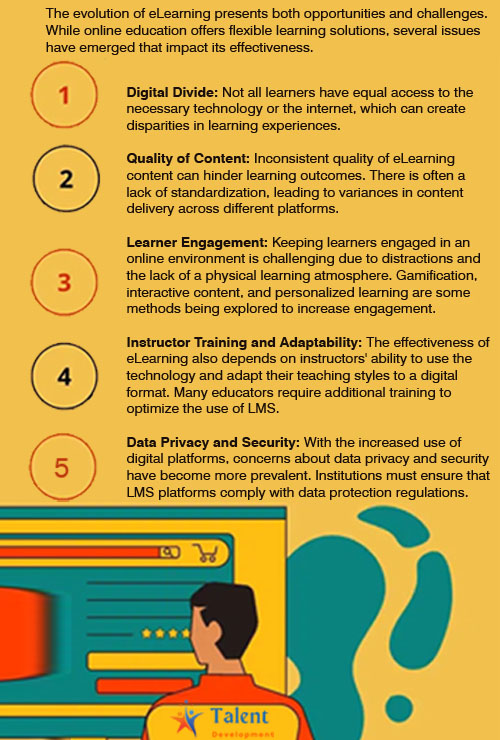
The evolution of eLearning presents both opportunities and challenges. While online education offers flexible learning solutions, several issues have emerged that impact its effectiveness.

1. Digital Divide: Not all learners have equal access to the necessary technology or the internet, which can create disparities in learning experiences.

2. Quality of Content: Inconsistent quality of eLearning content can hinder learning outcomes. There is often a lack of standardization, leading to variances in content delivery across different platforms.

3. Learner Engagement: Keeping learners engaged in an online environment is challenging due to distractions and the lack of a physical learning atmosphere. Gamification, interactive content, and personalized learning are some methods being explored to increase engagement.

4. Instructor Training and Adaptability: The effectiveness of eLearning also depends on instructors’ ability to use the technology and adapt their teaching styles to a digital format. Many educators require additional training to optimize the use of LMS.

4. Data Privacy and Security: With the increased use of digital platforms, concerns about data privacy and security have become more prevalent. Institutions must ensure that LMS platforms comply with data protection regulations.

Through Users’ Eyes – Evaluating Learning Management Systems

Evaluating LMS quality from the perspective of users provides valuable insights into the platform’s effectiveness. User feedback, often collected through surveys and user testing, can highlight areas for improvement.

1. User Satisfaction Surveys: Regular surveys can measure satisfaction levels concerning content quality, usability, and support services. This information helps identify pain points and areas where the LMS may fall short of user expectations.

2. Usability Testing: This involves observing how users interact with the LMS to identify usability issues. Usability testing can reveal design flaws or navigation problems that may hinder the learning experience.

3. Feedback Loops: Establishing continuous feedback loops ensures that user input is considered in future updates. This approach fosters a culture of user-centered design, where platform improvements are driven by actual user needs.

Through Users’ Eyes - Evaluating Learning Management Systems

Recent Trends and the Emergence of UX in eLearning

The user experience has become a key focus in eLearning, with platforms increasingly prioritizing user-centric design. Several trends are shaping the future of UX in eLearning:

1. Microlearning: This trend involves delivering content in small, digestible segments that are easier for learners to absorb. Microlearning aligns with user preferences for quick, on-demand content.

2. Mobile Learning: As mobile device usage continues to rise, LMS platforms are adapting to offer mobile-friendly interfaces. Responsive design and mobile apps allow users to access learning materials from anywhere.

3. Artificial Intelligence (AI) and Personalization: AI enables personalized learning experiences by analyzing user data to recommend relevant content and adapt learning paths. AI-driven chatbots also provide instant support to users.

4. Gamification: Incorporating game-like elements such as points, badges, and leaderboards can enhance user motivation and engagement.

5. Learning Analytics: The use of data analytics to track learner progress and behavior helps institutions make data-driven decisions to improve the quality of eLearning.

Methodology – Design of the Survey

The research employs a survey-based approach to gather data on user experiences with LMS. The survey design focuses on assessing the quality management aspects of various LMS platforms, including usability, content delivery, and overall satisfaction. The survey questionnaire includes both closed and open-ended questions to capture quantitative and qualitative data.

1. Participant Selection: The survey targets a diverse group of LMS users, including students, instructors, and administrative staff, to gain a holistic view of the LMS quality.

2. Questionnaire Design: Questions are structured to cover various dimensions of LMS quality, such as content quality, system reliability, ease of navigation, and support services.

3. Data Collection: The survey is distributed through email invitations, social media, and educational forums to reach a broad audience.

Methodology - Design of the Survey
LMS Data Analysis and Results

Data Analysis and Results

The data collected from the survey are analyzed using statistical methods to identify trends and correlations.

1. Quantitative Analysis: Descriptive statistics, such as mean scores and frequency distributions, are used to summarize the survey results. Correlation analysis may be applied to explore relationships between different aspects of LMS quality.

2. Qualitative Analysis: Responses to open-ended questions are analyzed using thematic analysis to identify common themes and user concerns.

The results indicate that while many users are satisfied with the content and mobile accessibility of LMS platforms, there are ongoing issues related to usability, engagement, and technical support. Many users expressed a need for more interactive content and better technical stability.

Interpretation of Findings and Future Research

The survey findings suggest several areas where LMS platforms can improve:

1, Enhancing Usability: The results highlight the need for user-friendly interfaces and intuitive navigation. Future LMS designs should focus on simplifying workflows and minimizing clicks required to accomplish tasks.

2. Improving Content Quality: Users have indicated a desire for higher-quality content and more diverse learning materials. Incorporating multimedia elements and adaptive content could address these concerns.

3. Addressing Technical Issues: Ensuring technical stability and prompt support services is essential for maintaining user trust. Regular updates and robust testing protocols can help achieve this.

4. Increasing Learner Engagement: Gamification, interactive elements, and personalized learning experiences can make eLearning more engaging. Future research could explore the impact of these strategies on different learner demographics.

Interpretation of Findings and Future Research
Why Choose Talent Development LMS in Saudi Arabia?

Future Research

While this thesis has explored several key issues in LMS quality management, future research could expand on various aspects:

1. Longitudinal Studies on LMS Quality: Tracking user satisfaction over time could provide insights into how LMS improvements impact user experiences in the long run.

2. Comparative Studies Across Different LMS Platforms: Comparing user experiences across different LMS platforms could reveal the unique strengths and weaknesses of each system.

3. Exploring AI-Driven Personalization: Future studies could investigate the effectiveness of AI-driven personalization in improving learning outcomes and user satisfaction.

4. Accessibility and Inclusivity in LMS: More research is needed to evaluate how well LMS platforms cater to learners with special needs.

Conclusion

Emerging eLearning presents significant opportunities for enhancing education, but quality management remains a crucial challenge, particularly from a user experience perspective. The findings of this thesis underscore the importance of designing user-centric LMS platforms that prioritize usability, content quality, and technical reliability. As eLearning continues to evolve, incorporating trends like AI-driven personalization, mobile learning, and gamification will be essential for meeting the changing needs of learners. Continuous research and feedback-driven development will be vital to ensuring the ongoing improvement of LMS platforms and the overall quality of online education. 

We offer solutions like Talent Development Software, LMS for colleges, LMS for schools, LMS for corporations, and LMS for businesses, ensuring organizations have the tools they need to create a culture of learning and development. As the market evolves, Talent Development LMS remains committed to empowering organizations to adapt and thrive by providing comprehensive solutions that cater to diverse learning needs across industries.

Conclusion